
ForceCtrl (2025)
ForceCtrl: Hand-Raycasting with User-Defined Pinch Force for Control-Display Gain Application
Seo Young Oh, Junghoon Seo, Juyoung Lee, Boram Yoon, Sang Ho Yoon, and Woontack Woo
IEEE Transactions on Visualization and Computer Graphics (TVCG), 2024
Abstract
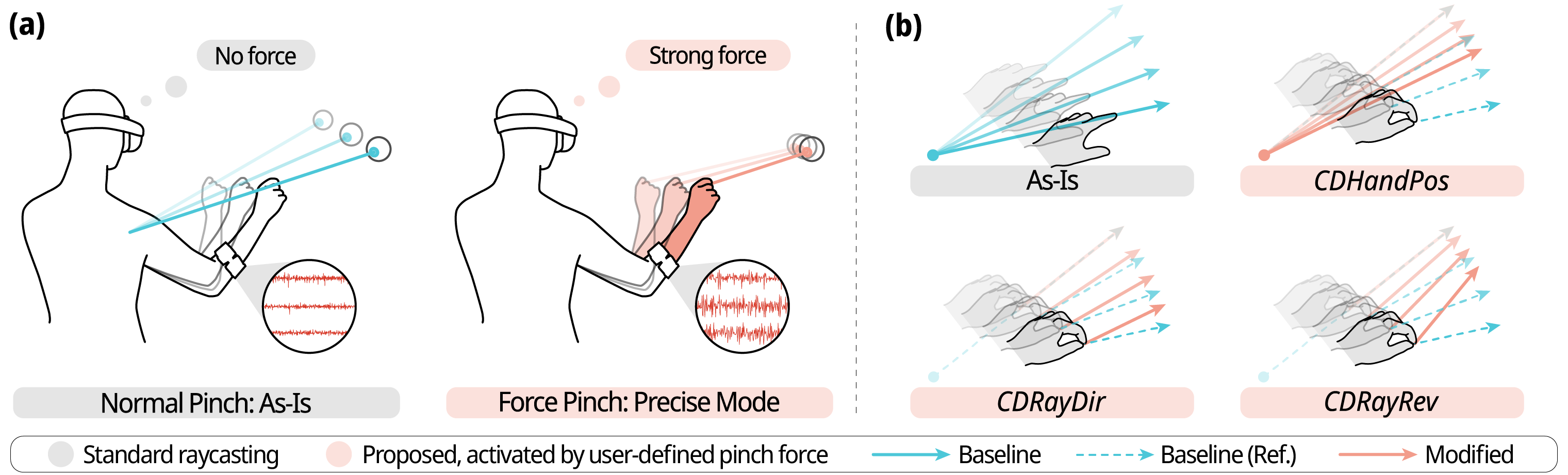
We present ForceCtrl, a novel 3D hand raycasting technique that enhances pointing precision by adjusting control-display (CD) gain based on user-defined pinch force. We introduce a target-agnostic approach for refining raycasting precision, overcoming limitations in human motor abilities. User-defined pinch force, detected with surface electromyography (sEMG), enables users to easily activate or deactivate CD gain during interaction. We propose three CD gain strategies and compare them through target selection and placement tasks. Our system reduces selection errors, placement jitters, and user workload, especially for distant targets in high-difficulty tasks. These results highlight the effectiveness of applying CD gain to hand raycasting and demonstrate the potential of user-defined pinch force as a robust input modality for precise hand interaction in AR/VR.
Demo Video
System Overview
ForceCtrl leverages user-defined pinch force to adjust the Control-Display (CD) ratio of the ray, allowing for high-precision interaction without requiring handheld devices.
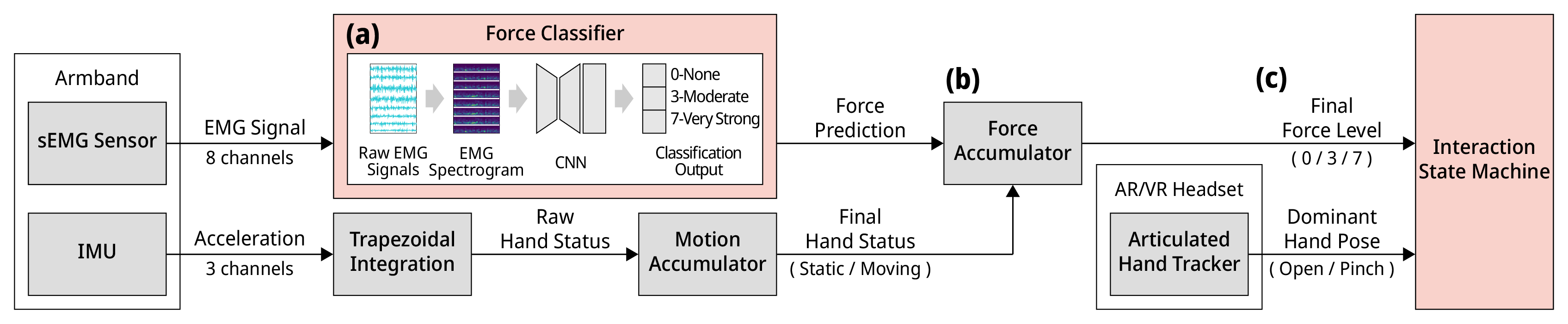
1. Force Classification via sEMG
The system uses a forearm-worn sEMG armband to detect pinch force levels. Unlike traditional methods that rely on fixed thresholds or MVC (Maximum Voluntary Contraction), our model classifies user-defined subjective force levels based on the Borg Scale (None, Moderate, Very Strong). A CNN-based model ensures robust classification across different users and sessions. This personalized approach accommodates individual physical differences and ensures consistent performance across various users.
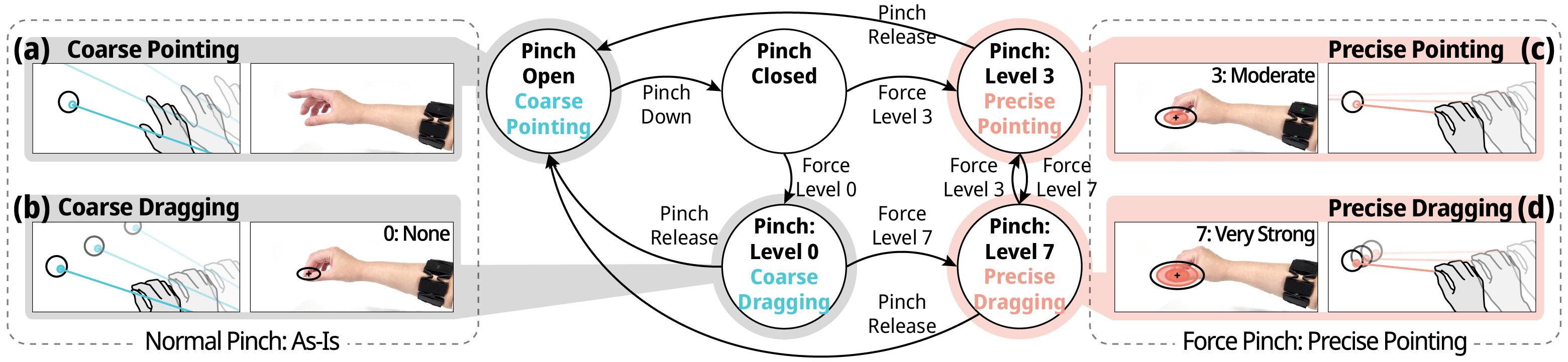
2. Interaction States and Transitions
A dedicated interaction state machine manages the workflow: it transitions from standard raycasting to a high-precision mode when force is detected. This seamless integration of force sensing and raycasting logic allows for stabilized pointing without the need for additional buttons or complex gestures.
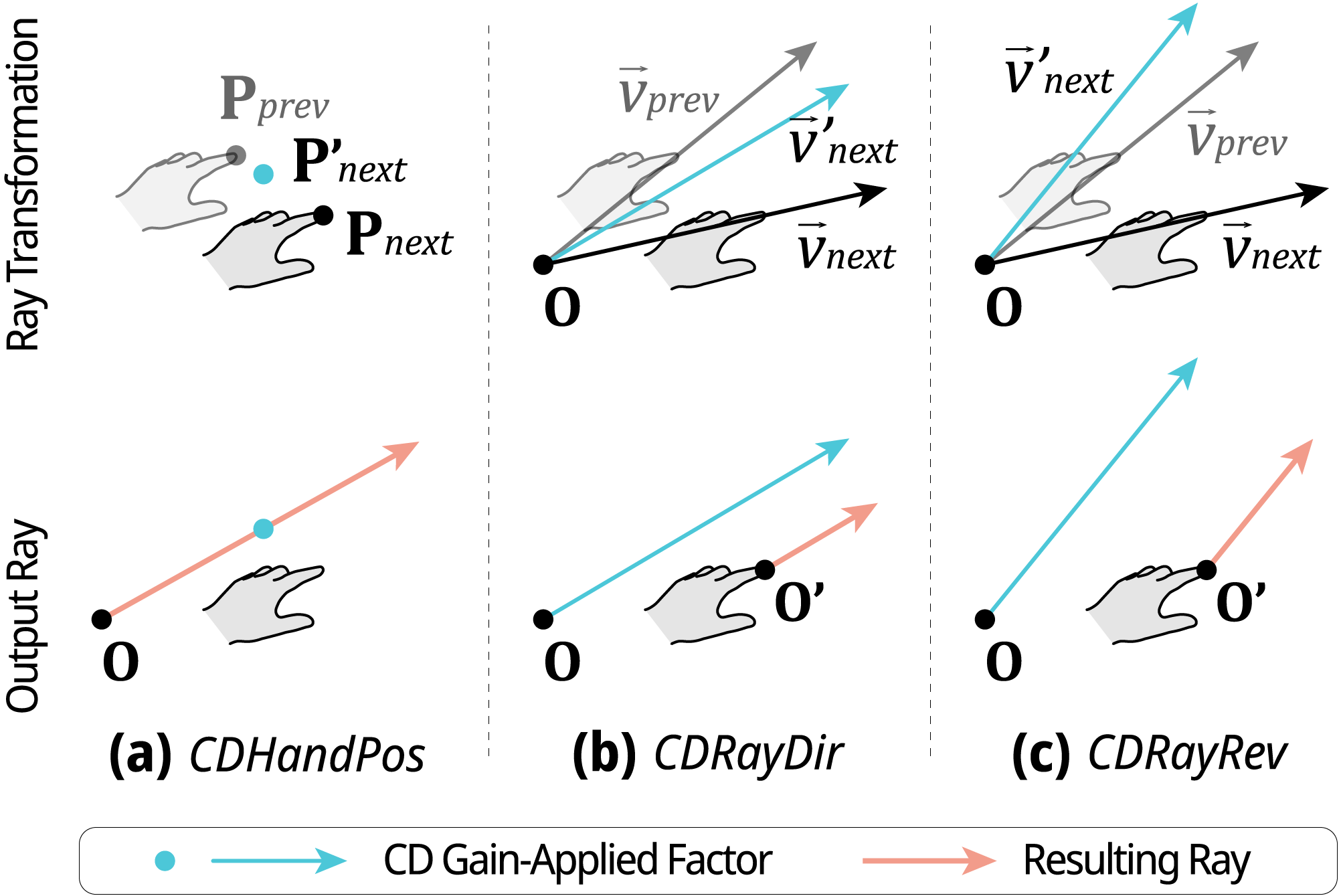
3. Ray Shifting Strategies for CD Gain Application
To apply CD gain to 3D raycasting, we proposed and evaluated three ray shifting strategies:
- CDHandPos: Scales the virtual hand’s position based on physical hand movement.
- CDRayDir: Scales the change in ray direction, maintaining the hand position.
- CDRayRev (Best Performing): Reverses and scales the directional change, causing the ray to converge. This method was found to be most effective for high-precision tasks at a distance.
Key Results
We conducted a user study (n=16) comparing ForceCtrl techniques against standard raycasting in target selection and placement tasks.
- Improved Precision: All ForceCtrl techniques significantly reduced selection errors and jitter compared to the baseline.
- Reduced Jitter: CDRayRev showed the most stable performance for distant targets.
- User Preference: Participants preferred CDRayRev for high-precision tasks due to its intuitive converging behavior, despite it deviating from physical hand pointing.
Citation
@article{oh2025forcectrl,
  title={ForceCtrl: Hand-Raycasting with User-Defined Pinch Force for Control-Display Gain Application},
  author={Oh, Seo Young and Seo, Junghoon and Lee, Juyoung and Yoon, Boram and Yoon, Sang Ho and Woo, Woontack},
  journal={IEEE Transactions on Visualization and Computer Graphics},
  year={2025},
  publisher={IEEE}
}